Reporting of side effects
I want to know more
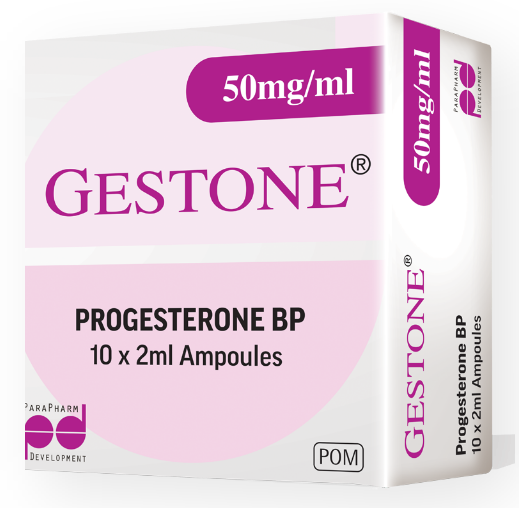
about Gestone®
(progesterone for injection)
This information is provided by the marketing authorisation holder to support administration of Gestone® following prescription from your specialist/healthcare professional; always follow the instructions and guidance given to you by your healthcare professional and please refer to them if you have any questions.
It is important to read the product package leaflet provided with your medicine. This information is not a substitute for the product package leaflet. The package leaflet contains additional important information on the use of the medicine.


What is Gestone®
is an intramuscular injection that contains progesterone.1,2 Progesterone is a hormone produced by the body during a typical menstrual cycle and during pregnancy to maintain the lining of the uterus.2,3
What is the role of progesterone?
The progesterone level rises in the second half (“luteal phase”) of a typical menstrual cycle when a follicle in the ovary becomes corpus luteum (CL) after it releases an egg. It is the CL that produces progesterone, to promote thickening of the endometrium in preparation to receive a fertilised egg. If implantation does not occur, progesterone falls and the endometrium thins, with the endometrial cells shed during menstruation.4,5
If implantation does occur, progesterone remains high to maintain the thickened endometrium to support implantation and nourishment of the growing embryo as well as preventing endometrial shedding and uterine contractions. These functions help to maintain the pregnancy.3
In the early weeks of pregnancy, progesterone continues to be produced by the CL in the ovary. From about week 10, the placenta takes over.3 Gestone® is usually prescribed for 8–16 weeks, and your specialist will decide what is the appropriate length of time for you to ensure your progesterone level is adequate until placental progesterone production is established.1


Why have I been prescribed Gestone®?
Gestone® is prescribed for women who are undergoing assisted reproductive treatment (ART), such as in vitro fertilisation (IVF).1,2 As part of your treatment, you will have received hormones such as follicle-stimulating hormone (FSH) and luteinizing hormone (LH) to produce and release eggs; these disrupt your usual cycle and may mean that the CL does not produce enough of the progesterone needed to support the endometrium. Gestone® is prescribed to supplement your natural production and help ensure you have an appropriate level of progesterone.3
Gestone® may also be prescribed in women to help early pregnancy to continue in cases where the body is not producing enough progesterone, where there have been 3 or more unexplained miscarriages, and for the treatment of dysfunctional uterine bleeding.1,2
Correct administration of Gestone®
Gestone® is given as an intramuscular injection, injected deep into the buttock.
A video on the correct injection technique with Gestone® can be found below.

How frequently will I need
to administer Gestone®?
Read more
Treatment will normally begin from approximately Day 15, or the day of your embryo or gametes transfer, and continue until Week 8–16 of your pregnancy. After this, and following successful implantation, your placenta will take over and begin to secrete its own progesterone.3 If you have any questions about the frequency of your Gestone® injections, please contact your clinic or specialist.

What is the correct dose of
Gestone® for me?
Read more
How do I inject
Gestone®?
Read more
The video below demonstrates how to inject Gestone® correctly and safely at home. It is important to follow the correct injection technique to ensure you are getting the most out of your treatment. If you have any additional queries regarding the injection technique with Gestone®, please contact your clinic or specialist.

What to expect with Gestone®
As with all medicines, Gestone® may cause side effects, although you may not experience all or any of them. For a full list of possible side effects, please refer to the Patient Information Leaflet. You can also report side effects directly via the Yellow Card Scheme at https://yellowcard.mhra.gov.uk/ or to Nordic Pharma at pv.uk@nordicpharma.com or call 01182 210150. If any of the side effects occur suddenly, or gradually, or without explanation, that you are concerned about, please seek medical attention immediately.
Frequently asked questions
Why have I been prescribed Gestone®?
Is the use of Gestone® new in ART?
What should I do if fragments of glass get into the ampoule when I open it?
What should I do if I or my partner cut ourselves accidently while opening the ampoule?
What type of needle should be used for the injection?
What do I do if the sharps bin is full?
What happens if there is blood in the syringe?
Is a Gestone® injection painful?
What should I do if the skin around the injection gets sore and inflamed?
What if I feel unwell after an injection?
How long will I need to do these injections for?
What should I do if I run out of Gestone®?
References
- Gestone® Summary of Product Characteristics. 2023.
- Gestone® Patient Information Leaflet. 2023.
- Cable JK, Grider MH. Physiology, Progesterone. May 2023. Available at: https://www.ncbi.nlm.nih.gov/books/NBK558960/. [Accessed Novembe
- Jain M, Singh M. Assisted Reproductive Technology (ART) Techniques. June 2023. Available at: https://www.ncbi.nlm.nih.gov/books/NBK576409/. [Accessed November 2023].
- Netdoctor. Gestone® (progesterone). Available at: https://www.netdoctor.co.uk/medicines/a8721/gestone-progesterone/. [Accessed November 2023].
- Labarta E, Rodríguez C. Progesterone use in assisted reproductive technology. Best Pract Res Clin Obstet Gynaecol. 2020;69:74–84.
- CIA Medical. How to Aspirate a Needle Before an Injection (And Why It’s Done). Available at: https://www.ciamedical.com/insights/how-to-aspirate-a-needle/. [Accessed November 2023].
- Pharmacy Times. Injection-Site Reactions and How to Manage Them. Available at: https://www.pharmacytimes.com/view/injection-site-reactions-and-how-to-manage-them. [Accessed November 2023].
Reporting of side effects
If you experience any side effects, contact the clinic where you are receiving treatment and talk to your doctor, pharmacist, or nurse. This includes any possible side effects not listed in the Patient Information Leaflet. Report side effects directly via the Yellow Card Scheme at https://yellowcard.mhra.gov.uk/.
You can also report side effects to Nordic Pharma at pv.uk@nordicpharma.com or call 01182 210150. By reporting side effects, you can help provide more information on the safety of this medicine.

For UK patients
The information on this site is intended for patients in the UK who have been prescribed Gestone®.
If you are a patient prescribed Gestone® in the UK, please
If you are not a patient prescribed Gestone® but would like further information, please refer to the Summary of Product Characteristics (SmPC) and Patient information leaflet (PIL) linked below.
Date of preparation: December 2023. Job code: GES/23/001a